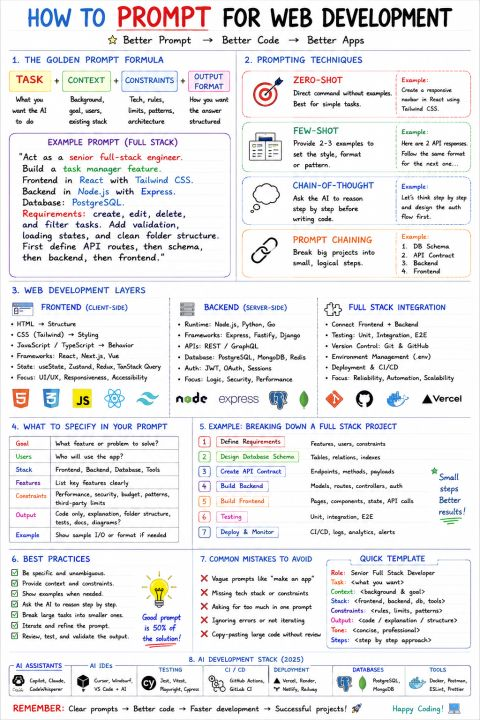
Effective prompting and understanding the core elements of web development are the two pillars of modern, AI-augmented engineering.
How to Prompt for Web Development
Prompting is "natural language programming" where the clarity of your input determines the reliability of the output. Professional prompting typically follows structured frameworks and logic-based techniques:
Prompting Frameworks
- TCRTE: Task (what to do), Context (background), Role (persona like "Senior React Dev"), Tone (formal/concise), and Examples (expected output).
- CRISP: Context, Role, Input, Steps, and Parameters (constraints like "use async/await").
Core Techniques
Zero-Shot
Issuing a direct command without prior examples; best for general syntax or simple explanations.
Few-Shot
Providing 2–3 examples of the desired code style or output format within the prompt to establish patterns.
Chain-of-Thought (CoT)
Adding the instruction "Let's think step by step" or "reason through this carefully" to significantly improve the model's logical accuracy.
Prompt Chaining
Breaking a massive request into sequential, atomic tasks (e.g., first generating an API contract, then the database schema, then the implementation) to prevent logical drift.
The Elements of Web Development
Web development in 2025 is categorized into three primary layers, supported by specific tools and specialized practices:
Frontend (Client-Side)
The visual and interactive layer.
- Core Tech: HTML (structure), CSS (styling, often utility-first like Tailwind), and JavaScript (behavior).
- Frameworks: Libraries like React, which manage components and state (using tools like Zustand or TanStack Query).
Backend (Server-Side)
The logic and data orchestration layer.
- Languages: Node.js, Python, or Go are common for building servers.
- Data: Designing databases (SQL like PostgreSQL or NoSQL like MongoDB) and API architectures (REST or GraphQL).
Full Stack Integration
The combination of frontend and backend, including testing (unit/integration) and version control via Git.
The AI Development Stack
Professional environments now integrate AI directly into the lifecycle:
Assistants
GitHub Copilot or Claude for code suggestions and boilerplate.
AI IDEs
Specialized editors like Cursor that maintain codebase-wide context for deep refactoring.
Specialized Domains
- Accessibility (A11y)Ensuring sites work for screen readers and users with disabilities.
- SecuritySanitizing inputs, managing authentication, and conducting AI-assisted vulnerability scans.
- DevOps/CI/CDAutomating the "ship-to-production" pipeline using GitHub Actions, Docker, and platforms like Vercel.